

In brief: Each supports a different aspect of mental health, and many people see both. A psychiatrist is a medical doctor who can prescribe medication. A psychologist supports the cognitive, behavioural and emotional aspects of mental health. Starting with either is reasonable, and each can point you to the other. Written by Kimberly Tng, Clinical Psychologist, Ardelle Psychology (Singapore and Australia). Last updated 16 November 2026.
If you are not sure whether to see a psychiatrist or a psychologist, here is the short answer. Each supports a different aspect of your mental health, and many people end up seeing both. A psychiatrist is a medical doctor who can prescribe medication. A psychologist is a mental health professional who supports the cognitive, behavioural and emotional aspects of mental health. If you are unsure where to start, starting with either one is reasonable, and each can point you to the other.
This is for you if you have been coping for a while, you are not sure whether what you feel is "bad enough" for a psychiatrist, and you would like to choose well.
The difference, in plain language
A psychiatrist is a medical doctor who has specialised in mental health. As medical doctors, psychiatrists can diagnose, prescribe and adjust medication, and consider how physical health and other medical conditions interact with how you feel.
A psychologist is trained in psychotherapy and psychological assessment. Psychologists work with how you think, feel, cope and behave, and with the patterns in your relationships and history that keep distress going.
Both roles focus on different aspects of your mental health and sometimes overlap. The diagram below shows the parts of a person's mental health that each professional often works with, and the areas they may both look at.
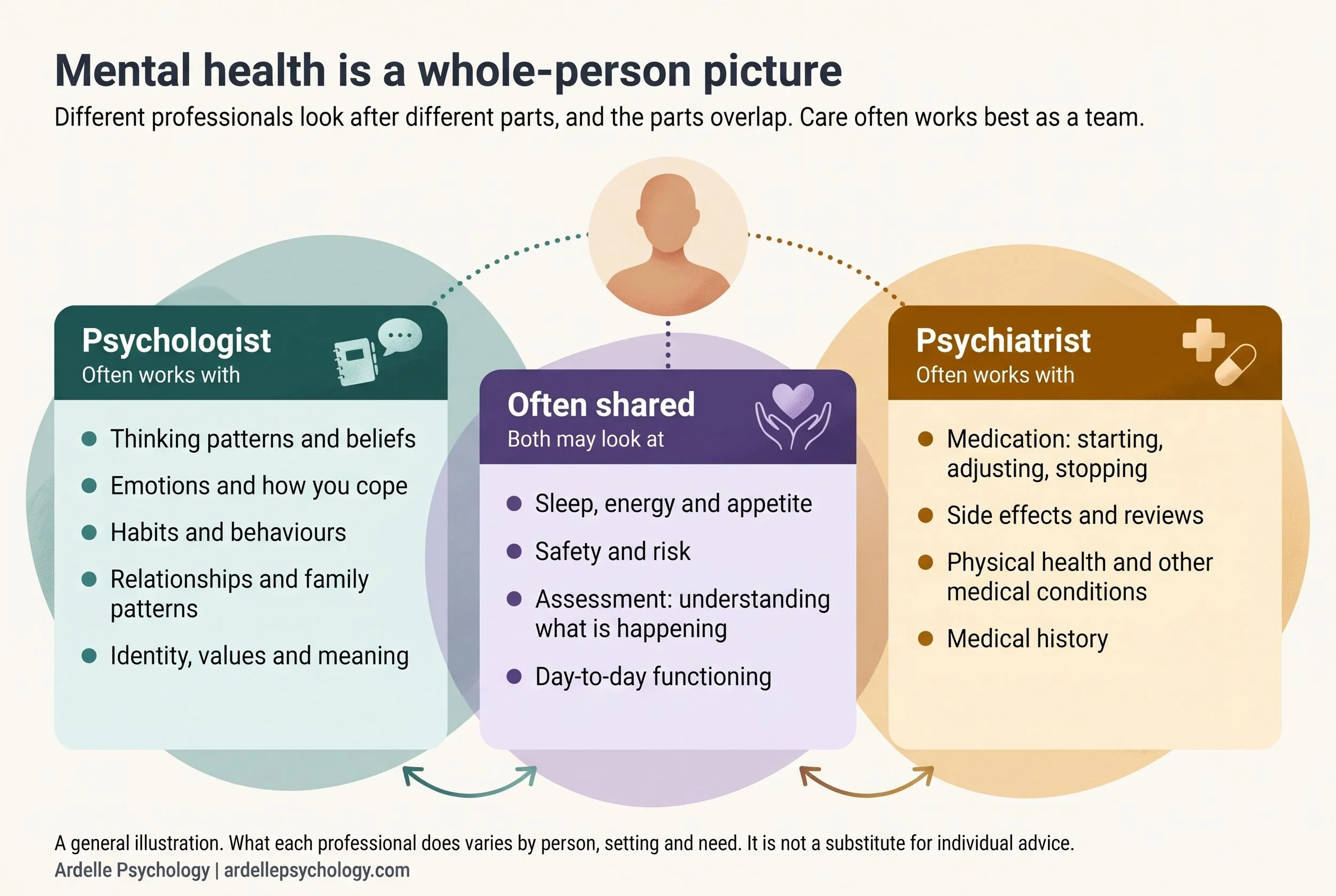
Infographic outlining the role differences between a psychiatrist and a psychologist.
Which should you see first?
There is no single right order. Here is one way to think about it.
If what you want most is to understand yourself and change patterns, such as how you react under pressure, how you talk to yourself, how you cope, or how family and work shape you, a psychologist is a natural place to start.
If you want to talk through whether medication might help, or you are already on medication and want a review, start with a psychiatrist. A GP can also be a first stop.
If you are not sure, book whichever is easier to reach. A good clinician will tell you if the other would help too.
If you feel unsafe, or you are worried about your safety or someone else's, do not wait for an appointment. In Singapore you can call 995 for an ambulance, SOS at 1767 (24 hours), or the IMH Mental Health Helpline at 6389 2222 (24 hours). [VERIFY these numbers against official pages before publishing.]
Should I be on medication?
People tend to arrive at this question with a feeling attached. For some, medication feels like the thing that will finally make the distress stop, without further action on their part. For others, it feels like something to avoid, often because of fears about side effects or about what taking it would say about them.
Regardless, the fear is valid and worth articulating to your mental health professional because these beliefs and fears are an important part of your mental health support too.
In fact, you are not married to any approach. It is not uncommon for psychologists to work with clients who are not on medication, and to recommend a psychiatric referral as needed so a concurrent medication approach can be discussed. It is also not uncommon for psychologists to work with clients on medication compliance, supporting medication cessation, and understanding clients’ resistance to medication.
Seeing both: why they need to talk
Seeing both a psychiatrist and a psychologist is not a sign of weakness or deficiency. In fact, for many, it means they have a team.
A key consideration to harnessing your team’s expertise, is to understand how they share information to best support your care. In public hospitals, notes and charts are typically centralised, so what one clinician knows is usually visible to the other. However, if one or both of your clinicians are in private practice, information flows differently, and each may only know what you tell them.
That matters most when you see a psychiatrist only a couple of times a year. In a short appointment, you may be asked how you have been, and your answer can be shaped by the last couple of weeks and by how you feel that day. For some people, recent events loom larger than the months before them, which makes the picture look better or worse than it has been overall.
This is where an update memo can help. With your consent, your psychologist can write a brief memo to your psychiatrist. It may include:
A summary of the interventions you have worked on together
Topics of concern that have come up
Results from standardised questionnaires, completed over the months
Together, these give your psychiatrist a view of how things have changed across time, not just a snapshot of the moment. The psychiatrist can use that context to inform their decisions about starting, increasing, decreasing or stopping medication. The decision stays with them, because prescribing is theirs to make. Questionnaire scores are one input among several and do not replace a clinical assessment.
A few things to keep in mind:
Sharing happens with your consent. You can ask what will be included before it is sent.
Please do not change or stop medication without talking to your prescriber. The NICE guideline advises people to talk to their prescriber before stopping and says stopping is usually done in stages.
Good care involves regular communication between professionals.
Are there situations where I should go straight to a psychiatrist? When difficulties are long-standing or high-risk
Yes. If you are at risk of hurting yourself, seeing of hearing things others do not, or have a significantly low body weight due to difficulties with eating, please seek psychiatric support at the nearest emergency room. Physical health and mental health are two parts of the same picture. If this sounds like you or someone close to you, a first step can be as simple as a GP visit or booking a therapy consult. You do not need to feel "sick enough" first.
Practical steps in Singapore
Start with a GP or polyclinic if you want a public pathway. IMH asks for a referral letter from a polyclinic (or a CHAS clinic, for CHAS cardholders) for subsidised rates. Non-subsidised patients can request a particular doctor. Check IMH's current page before you go.
Private clinicians set their own booking processes and fees, so it is worth asking each clinic directly.
Costs: see our guide to therapy costs in Singapore and therapy and insurance.
Confidentiality: if you are wondering what gets shared and when, read confidentiality in therapy.
Not sure what to expect? See what to expect in your first session and types of therapy.
If you would like a place to start
If you are weighing up who to see, a Discovery Call is a low-pressure way to talk it through. We can work out whether therapy fits now, or whether a psychiatric consult should come first.
If you are still deciding, the free workbook Finding the Right Therapist walks you through the questions to ask.
Frequently Asked Questions
Should I see a psychiatrist or a psychologist first?
Either is a reasonable starting point. A psychiatrist is a doctor who can prescribe medication, so they are a natural first stop if you want to discuss medication. A psychologist works with the thinking, emotional and behavioural side, so they are a natural first stop if you want to understand and change patterns. Both can refer you to the other.
Can a psychologist prescribe or change my medication?
No. Medication decisions sit with doctors such as psychiatrists. A psychologist or counsellor can share a summary of your work together, with your consent, so your prescriber has more context. Please do not change or stop medication without talking to your prescriber.
Can my psychiatrist and psychologist share information about me?
Yes, with your consent. In public hospitals, records are typically centralised. In private practice, information flows differently, so sharing usually has to be arranged and agreed with you. A written update memo covering interventions, topics of concern and questionnaire results is one way to do this.
Does combining therapy and medication work better than either alone?
For moderate and severe depression, a 2020 review of 101 trials found that the combination was more likely to produce a response than either alone. The evidence is stronger for depression than for other conditions, the trials were mostly short, and results are averages. Your own circumstances and preferences matter.
Does Ardelle Psychology offer sessions in Singapore and Australia?
Ardelle Psychology offers in-person sessions in Singapore and telehealth sessions in Singapore and Australia. The referral and public-hospital pathways described in this article are Singapore's; Australia's pathways differ.
References
National Institute for Health and Care Excellence (2022). Depression in adults: treatment and management (NG222). Recommendations 1.4.1, 1.4.13, 1.5.3, 1.6.1, 1.16.2.
National Institute for Health and Care Excellence. Eating disorders: recognition and treatment (NG69). Physical health assessment, monitoring and management.
NIHR Evidence. Plain-language summary of Cuijpers, P. et al. (2020), combined psychotherapy and pharmacotherapy for depression, World Psychiatry. (Summary read; original paper not read.)
Institute of Mental Health, Singapore. Appointments & Referrals page.
SGH-AHPEDIA / ask.gov.sg. Definitions of psychologist and psychiatrist.